

On 1 October, reports emerged that OpenAI had fired three researchers from their Safety and Alignment Team: Jasmine Wang, Tomek Korbak, and Mikita Balesni. Details of exactly why are sparse. OpenAI told the Wall Street Journal that the researchers had been dismissed for “violating [its] policies on accessing and handling sensitive company information”.
In typical AI safety fashion, new information came to light about this incident while I was writing this blog post. Initially, we knew very little about why the firings had occurred. Then, the former employees in question started speaking out. It turns out that they have not been given satisfying explanations for their dismissals. Jasmine reports being fired for accidentally accessing a sensitive email, despite having previously requested to be removed from the account, and having flagged the issue within minutes. Tomek and Mikita report having been dismissed for “speaking too much to third party safety organizations”, with Tomek specifically naming METR (who had conducted an independent investigation of the HuggingFace incident weeks earlier) as the organisation in question in his case. Both convey confusion about this reasoning since – as employees responsible for liaising with external companies during safety efforts – talking to third parties was quite literally their job. All this has led the former employees themselves, and most sensible observers who trust their accounts, to conclude that no satisfying explanations were offered because they don’t exist. OpenAI responded by saying that they absolutely, definitely didn’t fire the researchers for raising safety concerns, but for an unspecified “significant breach of trust” that they conveniently failed to elaborate on. Given all this, it’s hard not to assume that OpenAI is attempting to ice out employees that prioritise safety over its commercial interests. It really doesn’t look good.
Did OpenAI violate whistleblower protection laws?
The short answer to this question is no – despite outrage from observers such as Texas congressman Greg Casar at OpenAI’s apparent move to “fire whistleblowers”.
Under California’s SB53, frontier lab employees are protected if they report information to the Attorney General, a federal authority, or a person with “authority” over the covered employee. So there are no protections for employees who want to report information to a third-party safety organisation. This is somewhat ironic, in that the Act also requires labs to describe the extent to which third parties are used to assess catastrophic risk in their safety frameworks and transparency assessments. But it doesn’t actually protect the employees who talk to them.
Employees are also quite strictly limited in what they can report without retaliation; they must believe that their lab’s activities pose a “specific and substantial danger to the public health or safety resulting from a catastrophic risk”, or that it is in violation of the Act itself. So even if organisations like METR were covered, it’s unclear that, say, the details of the HuggingFace hack would have met this bar, since the incident itself did not clearly pose a direct public safety risk. Other general whistleblower protection laws are enforced in California, such as California Labor Code §1102.5 and the federal Defend Trade Secrets Act, but these are designed for employees to report violations of the law, rather than activities which are legal but carry risk, and also only cover reports to law enforcement, government officials, or internal channels.
Embedding auditing doesn’t work without strict protections for lab employees
There’s an unfortunate paradox here: among a growing buzz around the idea of “embedded auditors”, AI companies are clearly looking to share information with external safety organisations as a means of reducing risk, but there are no legally enshrined protections for employees who share said information. In the words of Fortune, “[OpenAI] is drawing a line between sanctioned and unsanctioned sharing with outside safety groups at the same time the industry is, slowly, inviting those groups in”. Even though labs are ostensibly granting access to safety organisations, how much access they grant is at their discretion. OpenAI also drew criticism for how little information (and time) it allowed METR in order to complete its investigation of the HuggingFace hack.
For all the talk of embedded evaluators, no proposal fleshes out in detail how employees would be protected under such a regime. Dario Amodei was the first lab CEO to propose the idea in his September blog We Must Pace The Frontier, with Sam Altman quickly vowing to match Anthropic’s commitment to embedded auditing. But Dario’s blog is fairly sparse on detail about how this would be implemented, and doesn’t touch on the idea of legal protections for employees. He says that evaluators should be offered “employee-like access” to Anthropic premises and information, and that the company will establish “strong internal norms reinforcing reviewers’ access to relevant information, including through live conversations with employees”. This sounds great, but as a frontier lab employee, I’m not sure I would feel comfortable being my most Consistently Candid under the cover of mere “norms”. This state of affairs still leaves employees exposed to risk if they accidentally share the wrong thing. The recent spate of firings seems likely to result in a pretty nasty chilling effect. Tomek, Jasmine and Mikita make this concern explicit in an open letter authored after their dismissals, which urges OpenAI to “set out clearly how employees may work with external safety organizations, so that no one has to guess where the shifting lines now are”. They want the company to “publicly reaffirm its culture of transparency and openness” so that employees feel comfortable making necessary disclosures to third parties. But I think recent events demonstrate that “culture” is not enough. OpenAI’s culture appears to be thoroughly cooked, and I am not sure that any amount of public or private reassurance would restore employees’ confidence in it.
What can we do about this?
The obvious remedy to this situation would be whistleblower protection laws that cover disclosures to third-party safety organisations. This might seem like a bit of a pipe dream, but I contend that many AI safety policy developments that have occurred over the last few years would once have seemed like pipe dreams, so this idea seems worth floating.
There is clear precedent here, in the US and elsewhere. In the UK, the 1998 Public Interest Disclosure Act (PIDA) designates bodies that whistleblowers can contact across a wide range of sectors. Most are government regulatory bodies – but some aren’t. For example, if you’re concerned about a child’s welfare, you can contact the National Society for the Prevention of Cruelty to Children (NSPCC), which is a charity. If you witness harassment or discrimination in the media industry, you can contact the Creative Industries Independent Standards Authority (CIISA). Under the UK’s Local Audit and Accountability Act (2014), local councils must be appointed an external auditor to oversee them. These are private firms, not state bodies, and disclosures to them by council employees are protected.
Ok, but what about in the US? They do this too. The best example is in the medical sector, where healthcare workers can make protected disclosures to Patient Safety Organizations (PSOs). These are often private organisations. There has to be a genuine patient safety concern, but this feels like a pretty close analogy. And California is already part of the way there. On 9 September this year, Governor Newsom signed two relevant Acts into law: The Independent Verification Organizations Act directs Government Operations Agency (GovOps) to designate “independent verification organisations” (IVOs), which are outside bodies qualified to assess AI systems’ safety risks. A separate bill, AB 1405, creates an AI Auditor Registry which designates bodies to conduct future audits of AI companies as required by law. The list doesn’t actually exist yet – and likely won’t until a deadline of late 2027 – but both these acts lay the groundwork for determining who prescribed auditors will actually be. Maybe I’m naive, but it doesn’t seem like a huge legislative leap to protect lab employees who disclose information to these auditors. This is a thing that you can do, and that is done in other contexts. If we were treating the issue of catastrophic AI risk with even the fraction of the seriousness it deserves, we would put a huge legislative effort behind ensuring that employees can speak freely to independent organisations without fearing for their jobs.
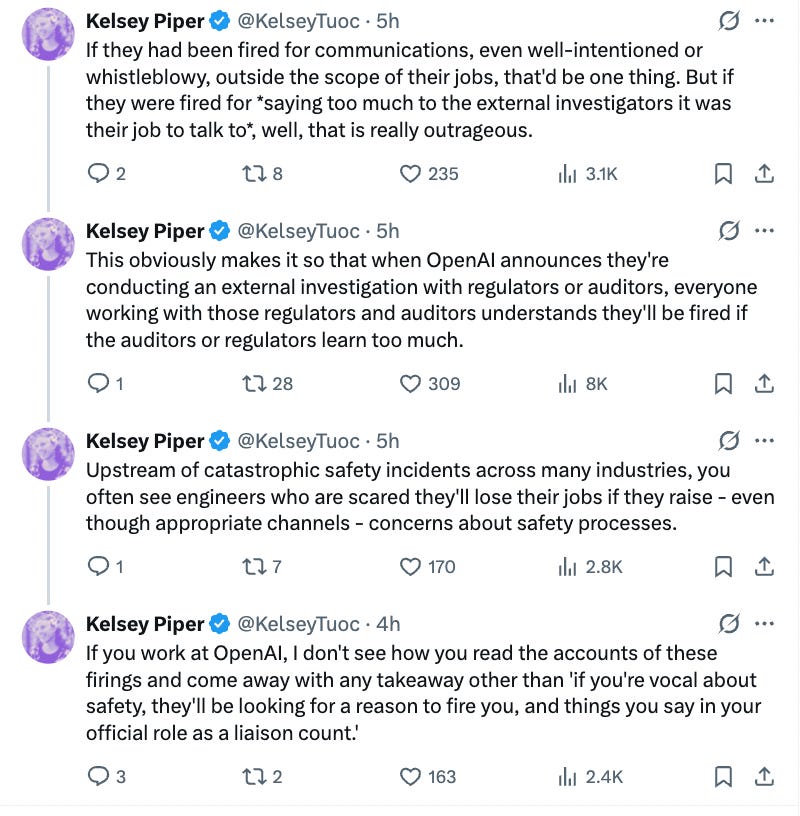
I am less excited about the prospect of embedded auditing in the wake of the OpenAI firings. I do not understand how it is supposed to work in a context where AI companies can simply chill the speech of concerned employees and fire them for doing their jobs without a satisfactory explanation. Kelsey Piper illustrates the direness of this situation well:
We need to do much, much better.
I was a little dismissive of Daniel Kokotiljo's advocating for strict whistleblower protection rules as being pretty weak sauce but I'm reconsidering.
Yeah.
We might forgive stupid moves in crazy times, so it might help considerably if these three were unfired.
(Well, you said float crazy sounding propositions. It might truly be selfishly useful for OpenAI to signal "we notice we are confused.")